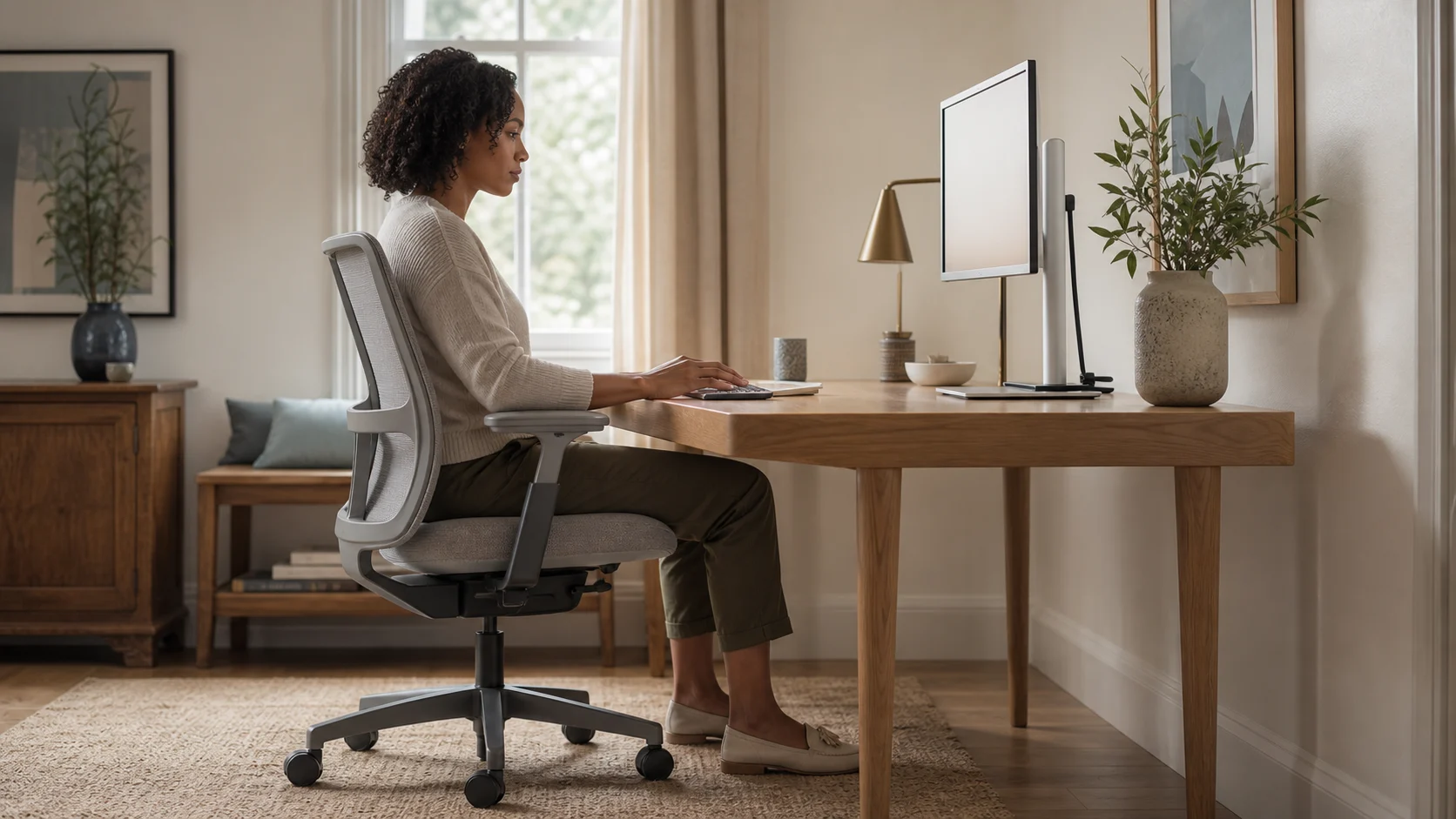
Most fixed desks are around 72–75 cm high because that range works tolerably for many adults. “Tolerably” is not the same as personally comfortable. Your useful setting depends on your body, chair, keyboard, and posture.
Find your seated desk height
Sit all the way back in your chair with your feet supported. Relax your shoulders and bend your elbows so your forearms are roughly parallel to the floor. The underside of your elbow is your target keyboard-surface height.
Bring the chair up or down until the desktop meets that position. If the chair must rise to meet a fixed desk and your feet lose contact with the floor, add a footrest. If the desk is too low even with the chair correctly set, stable risers may help.
Find your standing desk height
Stand in the shoes or slippers you normally wear. Keep knees soft and shoulders loose. Bend your elbows near 90 degrees, then raise the desktop until it sits just below them. Your wrists should stay straight while typing.
A rough starting estimate is about 62% of your body height. The right setting can shift with keyboard thickness and arm proportions, so save a preset only after working there for several minutes.
Desk height is only half the setup
After the keyboard surface is right, move the screen independently. Place it roughly an arm’s length away, with the top at eye height or a little lower. Laptop-only work usually benefits from a stand plus an external keyboard and pointing device.
Do not optimize away movement
No measurement makes one position healthy forever. A useful setup makes the next position easy: recline for reading, sit upright for focused input, stand for part of a call, and walk when a task ends.
Your desk, worked out